

- Number of cylinders: the number of cylinders commonly used in automobile engines are 3, 4, 5, 6, 8, 10, 12. Displacement of 1 liter below the engine commonly used three-cylinder, 1 ~ 2.5 liters are generally four-cylinder engine, 3 liters of the engine are usually 6-cylinder, 4 liters of 8-cylinder, 5.5 liters more than 12-cylinder engine. Generally speaking, under the same cylinder bore, the more the number of cylinders, the larger the displacement, the higher the power; under the same displacement, the more the number of cylinders, the smaller the bore, the speed can be increased, to obtain a larger boost power.
- Cylinder arrangement: general 5-cylinder engine cylinders are arranged in an in-line manner, a few 6-cylinder engines also have an in-line manner, in the past there has been an in-line 8-cylinder engine. Inline engine cylinder block into a word lined up, cylinder, cylinder head, and crankshaft structure is simple, has low manufacturing costs, low-speed torque characteristics, fuel consumption, compact size, and is more widely used, the disadvantage is that the power is lower. General 1-liter or less gasoline engines are mostly 3-cylinder inline 1 ~ 2.5-liter gasoline engines are mostly 4-cylinder inline, some four-wheel drive vehicles use 6-cylinder inline, because of its small width, can be arranged in the small side of the supercharger, and other facilities. Inline 6-cylinder dynamic balance is better, vibration is relatively small, so also for some of the middle and high pole cars.
- 6~12 cylinder engines generally use a V-shaped arrangement, of which the V10 engine is mainly installed in racing cars. V-shaped engine length and height dimensions are small, the arrangement is very convenient, and generally believe that the V-shaped engine is more advanced, but also become one of the symbols of the level of the sedan.V8 engines are very complex structure, the manufacturing cost is very high, so the use of the less, the V12 engine is too large and too heavy, only a very few premium cars used. Very few premium sedans are used. Volkswagen has recently developed a W-type engine, W8 and W12 two kinds, that is, the cylinders are arranged in four rows of staggered angle, compact shape.
- The number of valves: car engines generally use 4-valve structure per cylinder, that is, 2 intake valves, and 2 exhaust valves, to improve the efficiency of the intake and exhaust; foreign companies began to use a 5-valve structure per cylinder, that is, 3 intake valves, 2 exhaust valves, the main role is to increase the amount of intake so that the combustion is more thorough. The number of valves is not the more the better, 5-valve can indeed improve the efficiency of the intake, but the structure is extremely complex, processing difficulties, the use less, the domestic production of the new Jetta King the use of a five-valve engine.
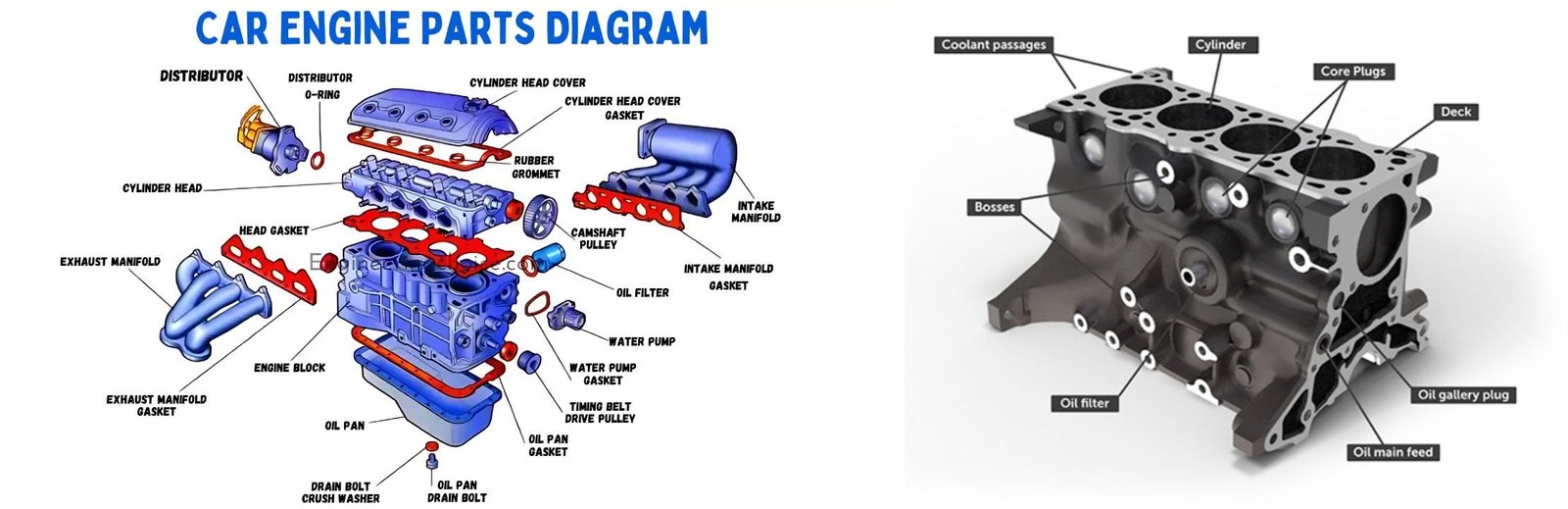
- Displacement: Cylinder working volume is the volume of gas swept by the piston from the upper stop to the lower stop, also known as single cylinder displacement, which depends on the cylinder bore and piston stroke. Engine displacement is the sum of the working volume of each cylinder, generally used (L) to express.
- Engine displacement is one of the most important structural parameters, it is more representative of the size of the engine than the cylinder bore and the number of cylinders, many indicators of the engine are closely related to the exhaust. For cars, displacement is only a relatively important technical parameter, it shows the car’s general power, equipment, and price level, but in China, car engine displacement has other significance.
- Maximum output power: The maximum output power is usually expressed in PS or KW. Engine output power with the speed of the relationship is very large, with the increase in speed, the engine power is also increased accordingly, but after a certain speed, the power instead of a downward trend. Generally in the car instructions in the highest output power at the same time the speed per minute to indicate (r/min), such as 100PS/5000r/min, that is, at 5000 revolutions per minute the highest output power of 100 horsepower.
- Maximum torque: the torque output from the crankshaft end of the engine, the torque is expressed in N.m/r/min, the maximum torque is generally found in the range of the engine’s middle and low speeds, and the torque decreases instead as the speed increases.
What are “Euro I” and “Euro II” standards?
In recent years, whether or not the emissions of automobiles meet the emission standards has become one of the hot topics that people are concerned about. Since September 1, 2001, the state banned the production and sale of carburetor cars, which further heated this hot topic. When it comes to emission standards, the relevant provisions and articles often appear in the “Euro I”, and “Euro II” standard reference, then what is “Euro I”, What are “Euro I” and “Euro II” standards?
According to the relevant information, “Euro I” and “Euro II” are the abbreviations for European Standard I and European Standard II. The European standard belongs to a specialized technical category, which is a unified directive formulated by the Commission of the European Economic Community (EEC) 91/441/EEC, covering the relevant provisions on emissions of different types of vehicles.
Now take the design of the number of passengers not more than 6 (including the driver), the total mass of not more than 2.5 tons of cars, for example, in the period from January 1, 1999 to December 31, 2003, must meet the emission limit values are: carbon monoxide not more than 3.16 g / km, hydrocarbons not more than 1.13 g / km; in addition, diesel emissions of particulate matter not more than 0.18 g / km, the durability of 50,000 km. More than 0.18 g / km, durability of 50,000 kilometers. These are the relevant provisions of the European I standard. After January 1, 2004, these gasoline vehicles are required to emit no more than 2.2 g/km of carbon monoxide and 0.5 g/km of hydrocarbons, while diesel vehicles are required to emit no more than 1.0 g/km of carbon monoxide, 0.7 g/km of hydrocarbons and 0.08 g/km of particulate matter. These are the relevant provisions of the European II standard.
Factory direct sales of engines & AUTO parts AUDI, BMW, HONDA, HYUNDAI, LAND ROVER, TOYOTA, VW, etc. Piston, Valve Cover, Oil Pump, Cylinder block, and other accessories. looking for overseas dealers.