

If the engine is the heart of the car, then the piston can be called the heart of the “center”, then a small piston has those amazing things?
Piston function and material
The main function
The piston withstands the pressure of the combustion gases and transfers this force to the connecting rod to drive the crankshaft rotation. The working environment of the piston is very harsh, but also because of the high temperature, high pressure, and high reciprocating inertia force of the environment, the piston material has become very important.
Material
High temperature will bring about a decline in mechanical strength, with the abnormal, and uneven heat and cold, high load operation will cause piston cracking, deformation, and so on, so the piston material must have a large enough stiffness and strength, with good thermal conductivity and resistance to high temperatures, high pressure, and friction, and should try to use lightweight, low inertia force material, aluminum alloy is naturally the best choice; of course, even today there is still a very small portion of the piston would be Gray cast iron or heat-resistant steel is chosen as the material.
Piston construction and function of each part
Piston construction
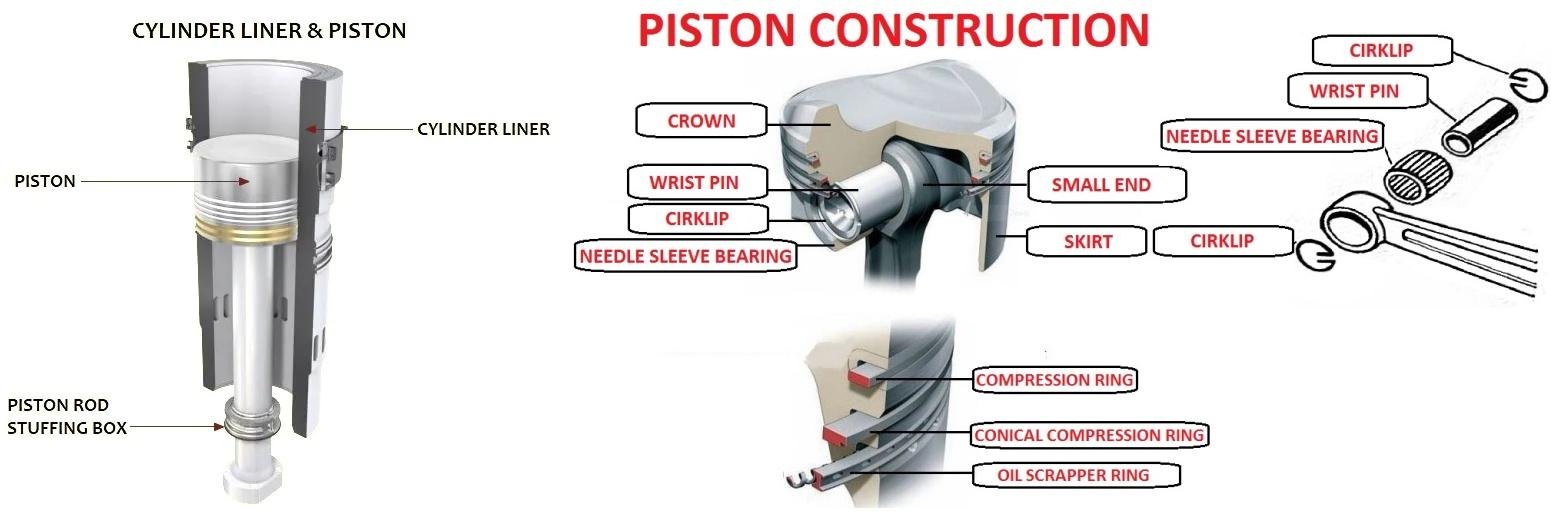
The piston can be divided into three parts, top, head, and skirt.
The top of the piston is mainly used to process the combustion chamber and reserve a certain space for the valve, and its shape is related to the shape of the combustion chamber and the size of the compression ratio. Currently, most gasoline engines use flat-top pistons, which are simple to process and have a small heat area, while for gasoline engines that want to adjust the compression ratio, concave or convex top pistons can be used as appropriate. The piston top is usually made into a specific shape for diesel engines to better promote combustion and form a secondary turbine.
The portion of the piston between the top of the piston and the lower face of the oil ring groove is known as the piston head. It has four functions, firstly, there is a piston ring groove machined on it to install the piston rings; secondly, it seals the cylinder together with the piston rings to prevent the combustible mixture from entering the crankcase; thirdly, it absorbs the heat coming from the top and transmits it to the cylinder wall to dissipate the heat; and lastly, it can also withstand the gas pressure and transmit the power to the connecting rod.
Generally speaking, today’s gasoline engines will use three piston rings, the first two for the gas ring, the bottom for the oil ring, at the bottom of the oil ring groove, but also machined with oil return holes or transverse grooves, the oil ring from the cylinder wall scraped off the excess oil sent back to the oil sump. Due to the close contact between the piston ring and the cylinder wall, the wear of the piston ring groove is more serious than the other areas of the piston, so many manufacturers will cast fiber-reinforced alloy rings into the head of the aluminum alloy piston, and at the same time in the first ring groove or the first two ring grooves inlaid with heat-resistant ring guards, to increase the strength of the piston and wear resistance. It is important to note that the piston rings should be placed at an angle to each other to ensure cylinder tightness.
Also to better cool the piston, some pistons are designed with an insulating groove above the first gas ring, which reduces the heat on the first gas ring and transfers more heat to the second and third piston rings, allowing for faster heat dissipation.
Piston function
Below the head, there is the piston skirt, which serves to guide the piston in reciprocating motion and to withstand the pressure from the lateral direction. In the ideal state, there should always be a uniform and suitable clearance between the cylinder and the piston, but the shape and volume of the piston will change under the influence of gas pressure and heat, so how to reasonably design the shape of the piston becomes crucial. Because the upper part of the piston is subjected to more heat, the piston expansion is up and down, so we must make the piston into a small round table; and according to the state of the piston force and so on, the top view on the piston skirt will increase in the direction of the piston pin hole axis, so in the manufacture of the piston skirt should also be processed into an ellipse in cross-section, and the ellipse long axis and the axis of the piston pin hole perpendicular to the long axis of the piston pin hole.
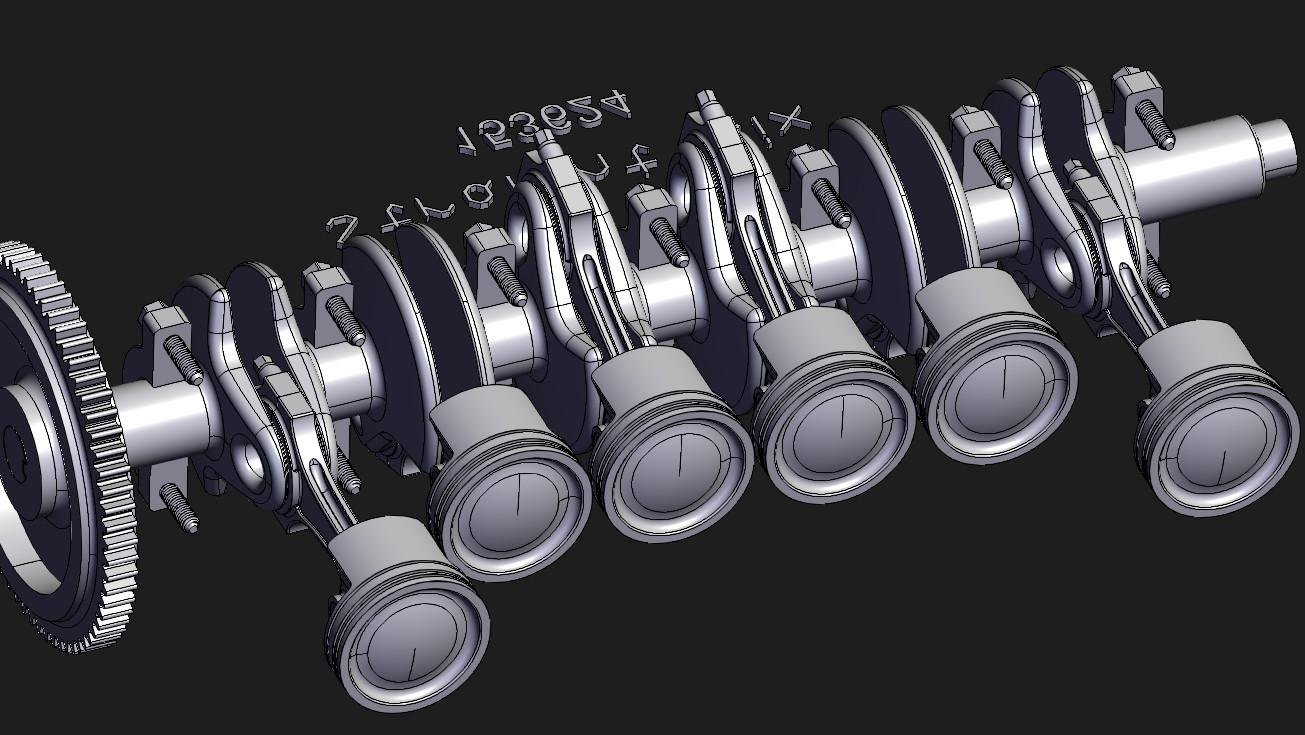
The piston pin is a device used to connect the piston to the connecting rod, through which the transfer of force between the piston and the connecting rod is accomplished. Due to the influence of the force from the connecting rod, the piston will knock on the cylinder wall, to avoid this situation, the design will be the piston pinhole position toward the side of the main thrust surface offset 1-2mm.
Piston surface treatment
According to different needs, we can also carry out different surface treatments for the piston if you want to reduce the heat absorption at the top of the piston and increase the thermal resistance, we can do hard film anodic oxidation on the top of the piston; to avoid cylinder pulling phenomenon when lubrication is not good and to reduce the wear and tear of the skirt, you can tin plating, zinc plating, or graphite coating of the skirt for the piston.
To summarize, as a high-speed reciprocating and vital auto part, the piston not only needs the above fine design but also requires ultra-high precision processing, which shows that this small piston contains a lot of technology.